


On this page
- When Were Scooters Invented?
- Who Invented the Scooter?
- What Did the First Scooter Look Like?
- The Types of Scooters
- Scooter Culture: History, Subcultures, and Modern Trends
- Scooter Rules and Regulations
- Experience Modern Scooter Technology: Varla Eagle One PRO All Terrains Electric Scooter
- Were Scooters Invented Before Bicycles?
- What Was the First Motorized Scooter Ever Made?
- Who Invented the Modern, Foldable Kick Scooter?
- Why Did It Take So Long for Electric Scooters to Become Popular?
- When Did Dockless Electric Scooter Sharing Networks Start?
- Who Is Credited with Inventing the Very First Kick Scooter?
- Who Invented the Autoped, the First Motorized Scooter?
- Who Invented the Modern Aluminum Razor Scooter?
- Who Invented the First Gas-Powered Vespa Scooter?
- Who Started the Modern App-Based Electric Scooter Sharing Concept?
Have you ever wondered what the history of scooters is? Where did electric scooters come from? Don’t worry, we’ve got you covered. In this blog, we’ll delve into the history of scooters and why a scooter was made. Let's get started. Scooter is a two-wheeled vehicle with a step-through chassis and footrest platform. It may sound strange but scooters have been with us for more than a century now.
When Were Scooters Invented?
The invention of the scooter occurred in stages across the 19th and 20th centuries, depending on the type of scooter.
1. Early Kick Scooters (Late 1800s – 1920s)
- Precursors: In 1817, Karl von Drais invented the Laufmaschine ("running machine" or velocipede), a two-wheeled wooden vehicle without pedals propelled by pushing off the ground.
- Homemade Kick Scooters: The recognizable foot-powered kick scooter was not created by a single inventor. In the late 19th and early 20th centuries (particularly the 1910s and 1920s), children in urban areas began assembling homemade scooters by taking roller skate wheel assemblies, attaching them to a wooden plank, and mounting a handlebar made from crates or 2×4s and pipes.
- Commercial Production: Toy manufacturers began mass-producing steel and wooden kick scooters in Europe and North America throughout the 1920s and 1930s.
2. Motorized Stand-Up Scooters (1915)
The Autoped: The first mass-produced motorized scooter was the Autoped, patented by Arthur Hugo Cecil Gibson in 1916 and manufactured by the Autoped Company of America from 1915 to 1921.
It featured an air-cooled 155cc engine mounted over the front wheel, a collapsible handlebar, and could reach speeds up to 20–25 mph.
3. Step-Through Motor Scooters (1930s – 1940s)
Vehicles like the Cushman (1936) in the U.S. and later the post-WWII Italian Vespa (1946 by Piaggio) and Lambretta (1947 by Innocenti) created the seated, enclosed-chassis motor scooter category that redefined urban transport.
4. Modern Aluminum Folding Scooters (1990s)
In the late 1990s, Swiss inventor Wim Ouboter (founder of Micro Mobility Systems) developed lightweight folding aluminum scooters using polyurethane inline skate wheels.
Distributed globally starting around 1999–2000 under the Razor brand, this design kicked off the modern micro-mobility era.
5. Modern Electric Scooters (2000s – Present)
Electric versions of the folding kick scooter emerged commercially in the early 2000s (such as Razor's electric models in 2003), before modern lithium-ion batteries and brushless hub motors enabled the app-based shared e-scooter boom starting around 2017.
Who Invented the Scooter?
No single person invented the scooter; its evolution spans over a century through distinct milestones.
Key Milestones in Scooter History
1. The Early Homemade Kick Scooter (Late 19th–Early 20th Century)
The concept started in urban areas around the 1890s to 1910s, where children attached roller skate wheel assemblies to wooden planks and attached makeshift handlebars using wooden crates or pipes.
No single patent holder claims this original DIY version.
2. The First Motorized Stand-Up Scooter — Arthur Hugo Cecil Gibson & Joseph Merkel (1915)
Gibson filed a US patent in 1915 (granted in 1916) for a self-propelled vehicle manufactured by the Autoped Company of America.
The Autoped featured a 155cc engine mounted over the front wheel and a foldable steering column—making it the direct ancestor to today's motorized and electric stand-up scooters.
3. The Seated Motor Scooter — Corradino D'Ascanio (1946)
Commissioned by Enrico Piaggio to design an affordable, clean, step-through personal vehicle for post-WWII Italy, aeronautical engineer Corradino D'Ascanio created the Vespa, defining the modern seated motor scooter category.
4. The Modern Folding Kick Scooter — Wim Ouboter / Gino Tsai (1990s)
Swiss entrepreneur Wim Ouboter designed the modern compact, folding aluminum scooter (founding Micro Mobility Systems).
Taiwanese manufacturer Gino Tsai (president of JD Corporation) engineered the lightweight aluminum folding mechanism with inline skate wheels that became the global sensation known as the Razor scooter in 1999–2000.
What Did the First Scooter Look Like?
The first mass-produced motorized scooter was the Autoped, introduced in New York in 1915 by the Autoped Company.
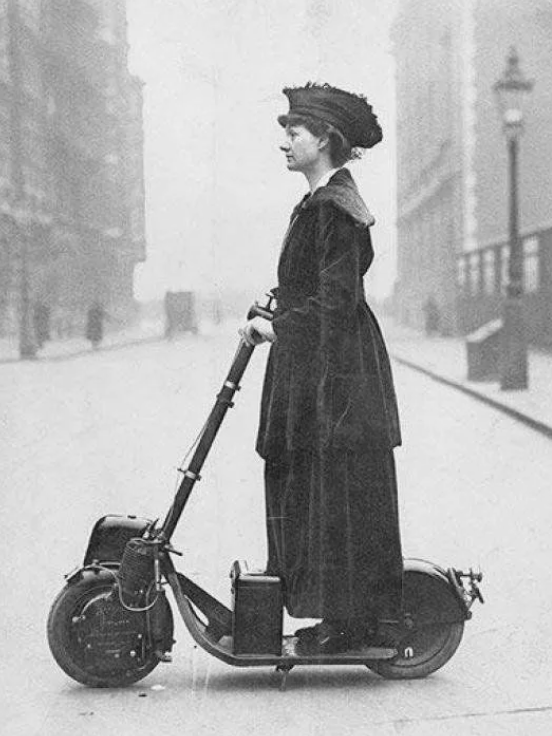
It looked remarkably similar to today's stand-up electric scooters, but with a bulkier, industrial chassis and a combustion engine mounted directly over the front wheel.
1. Key Visual & Mechanical Features
Front-Heavy Engine
A 155 cc, 4-stroke air-cooled gasoline engine sat directly above the front tire, encased in a rounded metal housing alongside a small fuel tank.
Low-Slung Steel Deck
Riders stood on a wide, low-clearance steel footboard suspended between two 10-inch solid rubber tires with rounded mudguards.
All-in-One Steering Column
It had no seat and no traditional handlebar controls. Instead, the steering column acted as the clutch, throttle, and brake:
- Pushing the handlebar forward engaged the clutch and accelerated.
- Pulling it backward disengaged the clutch and applied the brake.
Foldable Design
The entire steering column unlatched and folded flat over the footboard, locking into the rear fender so it could be carried or stowed in a hallway.
2. Non-Motorized Predecessors
Before the Autoped, "kick scooters" were predominantly homemade folk toys dating back to the late 19th and early 20th centuries.
Children made them by dismantling roller skates, nailing the two wheel assemblies to the bottom of a two-by-four wooden plank, and attaching an upright wooden post or wooden fruit crate with crude crossbar handles for steering.
The Types of Scooters
The word scooter covers several distinct vehicle designs, ranging from lightweight human-powered toys to high-speed road machines and medical aids. They fall into four primary categories:
1. Electric Kick Scooters (e-Scooters)
Motorized stand-up scooters powered by rechargeable lithium-ion batteries and hub motors.
- Commuter / City e-Scooters: Lightweight (25–40 lbs) and foldable with 8.5–10 inch wheels. Designed for last-mile transit and city streets with typical speeds of 15–20 mph (24–32 km/h) and 15–25 miles of range.
- High-Performance / Dual-Motor Scooters: Equipped with dual motors (2,000W–6,000W+), hydraulic disc brakes, and full suspension. Can reach speeds of 40–60+ mph with heavy frames (70–120 lbs).
- Off-Road e-Scooters: Feature knobby 11+ inch pneumatic tires, heavy-duty suspension arms, high ground clearance, and waterproof electrical enclosures for dirt, gravel, and rough trails.
- Seated e-Scooters: Stand-up frame geometry fitted with a detachable or integrated saddle and larger deck for longer urban commutes without rider fatigue.
2. Motor Scooters (Vespa-Style / Mopeds)
Step-through, seated two-wheel vehicles with a flat floorboard for the rider's feet, smaller wheels (10–16 inches), and automatic (CVT) transmissions.
- 50cc / Moped Class: Maximum speed usually capped at 30 mph (48 km/h). In many jurisdictions, these require only a standard driver's license rather than a full motorcycle endorsement.
- Mid-Size (125cc–200cc): The standard urban commuter class (e.g., Vespa Primavera, Honda PCX). Capable of 55–65 mph, making them suitable for main roads and suburban traffic.
- Maxi-Scooters (250cc–650cc+): Heavy-frame, highway-capable touring machines (e.g., Yamaha TMAX, Suzuki Burgman, BMW C 400). Feature wind protection, ABS, large under-seat storage, and speeds over 85 mph.
- Electric Mopeds / e-Motorcycles: Battery-powered step-through scooters replacing gas engines (e.g., NIU, Super Soco, Vespa Elettrica) with swappable batteries.
3. Manual / Kick Scooters
Human-powered scooters propelled by pushing off the ground.
- Classic Folding Kick Scooters: Aluminum deck and folding T-bar with small polyurethane wheels (100–120 mm), popular for kids and light urban hopping (e.g., Razor A series).
- Big-Wheel Kick Scooters: Outfitted with 200 mm (8-inch) or larger wheels (sometimes pneumatic air tires), rolling much faster and handling pavement cracks smoothly.
- Pro / Stunt Scooters: Non-folding, heavily reinforced one-piece decks and handlebars designed for skatepark jumps, grinds, and tricks.
- Three-Wheel / Lean-to-Steer Scooters: Two wheels in front and one in the rear; riders steer by shifting their body weight. Ideal for toddlers and developing balance.
- Kickbikes / Footbikes: Hybrid between a bicycle and a scooter, featuring a large front bicycle wheel (20–28 inches) and a low footboard for cardio fitness and long-distance touring.
4. Specialized & Medical Scooters
Purpose-built platforms for accessibility, recovery, or niche recreation.
- Mobility Scooters: 3- or 4-wheel electric vehicles with high-back captain's chairs, armrests, and front baskets designed for seniors or individuals with limited mobility (typically speed-governed to 4–8 mph).
- Knee Scooters: Non-motorized steerable platforms with a padded cushion designed to rest a non-weight-bearing leg following foot or ankle surgery.
- Self-Balancing Scooters: Gyroscope-stabilized units without handlebars (hoverboards) or single-wheel self-balancing platforms (electric unicycles / EUCs).
Quick Comparison of Scooter Types
| Type | Power Source | Primary Use | Typical Speed |
|---|---|---|---|
|
Commuter e-Scooter |
Lithium-ion battery |
Urban transit, last-mile |
15–20 mph |
|
Motor Scooter (125cc) |
Gas / High-V Electric |
City roads, suburban transit |
50–65 mph |
|
Maxi-Scooter (300cc+) |
Gas (250–650cc) |
Highway commuting, touring |
70–95 mph |
|
Stunt / Pro Scooter |
Human-powered |
Skateparks, tricks, jumps |
N/A (human effort) |
|
Mobility Scooter |
Lead-acid / Lithium |
Pavement, indoor accessibility |
4–8 mph |

Scooter Culture: History, Subcultures, and Modern Trends
Scooter culture encompasses several distinct global subcultures, ranging from 1960s British fashion movements to Southeast Asian daily life and skatepark action sports.
1. The British Mod & Classic Subculture
The most historically celebrated scooter subculture originated in 1960s Britain with the Mods (Modernists).
The Ride of Choice
Italian metal-body scooters—primarily Vespa and Lambretta. They were chosen over motorbikes because their enclosed engines and leg shields kept sharp tailored suits clean from road grease and splashes.
The Look
Fishtail parkas (U.S. Army M-51), bespoke Italian-cut suits, and scooters loaded with dozens of chrome mirrors, crash bars, and front-mounted spotlights.
Scooter Rallies & Scooterboys
By the late 1970s and 1980s, the "Mod Revival" gave rise to dedicated Scooter Clubs and coastal weekend rallies (such as Brighton, Isle of Wight, and Cleethorpes).
Scooterboys formed a subculture focused on tuning, racing, and custom paintwork, soundtracked by Northern Soul, ska, and punk.
2. Asian Commuter & Custom Scenes
Across Southern and Eastern Asia, scooters transitioned from basic utility into distinct regional lifestyles.
Taiwan & Japan (Scooter Tuning)
Taiwan has one of the highest scooter densities in the world. The culture revolves around small-displacement twist-and-go automatics (e.g., Yamaha Cygnus, SYM, Kymco), supported by a deep aftermarket for carbon-fiber bodywork, upgraded suspension, and track-day racing.
In Japan, the "Bosozoku" aesthetic occasionally crosses into stretched, low-riding maxi-scooters (e.g., Honda Fusion/Helix, Yamaha Majesty).
Indonesia's Extreme "Vespa Gembel"
Indonesia hosts one of the world's most unique scooter scenes, known as Vespa Sampah or Vespa Gembel (drifter/rebel Vespas).
Builders weld together reclaimed scrap metal, tree trunks, and dozens of extra wheels into sprawling, post-apocalyptic rigs powered by vintage 2-stroke Vespa engines.
Vietnam & Southern Europe
In cities like Rome, Barcelona, and Hanoi, the scooter is the urban heartbeat—defining cafe-hopping, lane-filtering, and daily social rhythms.
3. Action Sports: Freestyle & Stunt Scootering
Originating in the early 2000s following the Razor scooter craze, freestyle scootering evolved into an established action sport alongside skateboarding and BMX.
Hardware
Heavy-duty, non-folding aluminum and titanium decks, one-piece T-bars, integrated headsets, and urethane-core wheels designed to withstand high-impact landings.
Disciplines
- Park: Emphasizes technical air maneuvers, tailwhips, barspins, and overhead flairs in bowls and mega-ramps.
- Street: Focuses on grinds, stair drops, and wallrides utilizing urban architecture.
Governance
Sanctioned by organizations like the International Scooter Association (ISA) with major international competitions and pro signature parts.
4. Modern E-Scooter & Micromobility Culture
The late 2010s explosion of lithium-battery electric scooters created two modern groups.
Urban Commuters
Centered around utility, last-mile transit, folding portables, and dockless shared fleets (Lime, Bird).
High-Performance Enthusiasts
A niche community building and riding dual-motor hyper-scooters (e.g., Dualtron, Kaabo, NAMI) capable of speeds exceeding 50–60 mph (80–100 km/h), complete with motorcycle-grade protective gear and group rides.
Scooter Rules and Regulations
Scooter regulations vary significantly depending on whether the vehicle is a standing electric kick-scooter (micro-mobility) or a seated gas/motorized scooter (moped/motorcycle class), as well as by local state and municipal jurisdiction.
1. Electric Kick-Scooters (Micro-Mobility / Standing E-Scooters)
Across most jurisdictions (e.g., U.S. states and European municipal codes), stand-up e-scooters are treated similarly to electric bicycles.
| Category | Standard Regulations | Common Variations & Exceptions |
|---|---|---|
|
Where to Ride |
Bike lanes and public roads with low posted speed limits (≤ 25–35 mph). |
Sidewalk riding is prohibited in most commercial and downtown districts. Some suburbs permit sidewalk use if yielding to pedestrians. |
|
Speed Limits |
Generally capped at 15–20 mph. |
Geofenced shared fleets (e.g., Lime, Bird) are often restricted to 8–10 mph in high-pedestrian zones. |
|
Age Requirements |
Typically 16 years or older. |
Some jurisdictions allow riders aged 12–14 with parental supervision. |
|
Helmet Laws |
Mandatory for minors (usually under 16 or 18). |
Helmets are strongly advised for all ages, though adults (18+) are often exempt under state statutes. |
|
Licensing & Plates |
No driver's license, vehicle title, or registration required. |
A few states require a standard learner's permit or driver's license to operate on roads. |
|
Equipment |
Functional brake (stopping within 25 ft at 10 mph), white front headlight, and red rear reflector/taillight for low light. |
Audible warning bell/horn is frequently required by municipal codes. |
|
Traffic & Parking |
Must obey standard bicycle/vehicular traffic laws (stop signs, one-way streets, red lights). |
Parking must maintain minimum ADA clearance (usually 4–6 ft of clear sidewalk) and cannot block curb ramps or bus stops. |
2. Seated Motor Scooters & Mopeds (Gas or High-Power Electric)
Seated scooters fall under motor vehicle codes based on engine displacement or motor wattage.
Low-Power Scooters / Mopeds (≤ 50cc or ≤ 4,000–4,476W, Top Speed ≤ 30 mph)
- License: Requires a standard, valid driver's license (no motorcycle endorsement needed in most areas).
- Registration & Insurance: Usually requires state registration (decal or plate) and state-mandated minimum liability insurance (e.g., 25/50/15).
- Road Access: Allowed on city streets; prohibited on limited-access interstates, pedestrian sidewalks, and standard multi-use bike paths.
Highway / Maxi Scooters (> 50cc, e.g., 125cc, 150cc, 300cc+)
- Classified fully as motorcycles.
- Requires a Class M motorcycle license/endorsement, full vehicle registration, title, annual inspection (where applicable), and full motorcycle liability coverage.
3. Critical Universal Rules
Zero Tolerance for Impaired Riding
DUI/DWI laws apply across the board to mopeds, seated motor scooters, and stand-up electric scooters on public streets.
Single-Rider Restriction
Unless a seated moped is explicitly manufactured with dedicated pillion passenger pegs and a two-person seat, carrying extra passengers (especially tandem riding on stand-up e-scooters) is illegal and heavily cited.
No Earbuds / Distracted Riding
Riding with both ears covered by headphones or holding a mobile device while riding is banned under bicycle and motor vehicle codes in most cities.
Experience Modern Scooter Technology: Varla Eagle One PRO All Terrains Electric Scooter
From the early motorized Autoped to today's advanced electric scooters, scooter technology has come a long way. Modern riders no longer have to choose between convenient transportation and exciting outdoor adventures. The Varla Eagle One PRO All Terrains Electric Scooter brings these two experiences together.

Designed for riders who want more than a basic city commuter, the Varla Eagle One PRO features a powerful dual-motor system, all-terrain tires, and a robust suspension setup. Whether you're navigating city streets, exploring gravel paths, or tackling uneven terrain, it's built to deliver powerful acceleration, responsive handling, and a more comfortable riding experience.
Why Choose the Varla Eagle One PRO?
- Powerful Dual Motors: Deliver strong acceleration and the extra power needed for hills and challenging terrain.
- All-Terrain Performance: Large pneumatic tires provide traction and stability on pavement, gravel, and suitable off-road trails.
- Comfortable Riding Experience: An advanced suspension system helps absorb bumps and vibrations on uneven surfaces.
- Reliable Braking: Hydraulic disc brakes provide responsive stopping power for better control.
- Versatile Design: Ideal for experienced riders seeking a high-performance electric scooter for both daily transportation and outdoor recreation.
Looking for a Black Friday Electric Scooter Deal?
If you're planning to upgrade your ride, shopping for a black friday electric scooter deal could be a great opportunity to get more performance for your budget.
The Varla Eagle One PRO is worth considering if you prioritize motor power, riding comfort, and versatility over the lightweight design of an entry-level commuter scooter.
Explore the Varla Eagle One PRO All Terrains Electric Scooter and check the latest offers to find the right upgrade for your next adventure.
Were Scooters Invented Before Bicycles?
Bicycles were invented before scooters.
Both modern vehicles trace their lineage back to the same machine, but the bicycle developed into its distinct form decades before the scooter emerged.
The Shared Ancestor: 1817
In 1817, German inventor Karl von Drais created the Laufmaschine (or draisine / dandy horse).
It had two inline wheels, a steering handlebar, and a frame, but no pedals or deck—the rider sat on a saddle and pushed off the ground with their feet.
While historians consider this the direct ancestor of both vehicles, it was functionally the prototype of the bicycle.
The Evolution of the Bicycle
- 1860s (The Velocipede / Boneshaker): French inventors added rotary cranks and pedals directly to the front wheel, establishing the first true pedal-driven bicycle.
- 1870s (The High Wheeler / Penny-Farthing): Introduced large front wheels for greater speed per pedal rotation.
- 1885 (The Safety Bicycle): John Kemp Starley introduced the Rover Safety Bicycle, featuring equally sized wheels, a chain-driven rear wheel, and pneumatic tires—the exact blueprint of the bicycle used today.
The Evolution of the Scooter
- Late 1800s to Early 1900s (Kick Scooters): The first recognizable kick scooters—featuring a low, flat standing deck between two small wheels and an upright handlebar—began appearing as improvised homemade toys and early patent designs (such as C.F.W. Siebel's 1867 design and early 1890s foot-powered patents).
- 1915 (Motorized Scooters): The first mass-produced motorized standing scooter, the Autoped, debuted, long after the bicycle was already a globally established technology.
- 1990s (Modern Folding Scooters): The aluminum folding kick scooter (popularized by Razor and Micro) revolutionized the format for modern urban use.
By the time the kick scooter emerged as a distinct, purpose-built vehicle with a standing footboard, the bicycle had already evolved through its pedal-driven, high-wheel, and modern chain-driven stages.
What Was the First Motorized Scooter Ever Made?
The Autoped, introduced in 1915, is widely recognized as the first mass-produced motorized scooter.
Invented by Arthur Hugo Cecil Gibson and developed alongside motorcycle pioneer Joseph F. Merkel, the Autoped was manufactured by the Autoped Company of America in Long Island City, New York, from 1915 to 1921 (and later produced under license in Germany by Krupp until 1922).
Key Specs & Design Features
- Engine: A 155 cc, air-cooled 4-stroke engine mounted directly over the front wheel (Krupp models used a 191 cc engine). An electric battery-powered version was also briefly produced.
- Speed: Capable of reaching speeds between 20 and 25 mph (up to 35 km/h).
- All-in-One Steering Column: Riders controlled acceleration and braking using the handlebar column itself—pushing the handlebar forward engaged the clutch, while pulling it backward disengaged the clutch and engaged the front-wheel brake.
- Foldable Portability: The steering column folded flat and locked onto the footboard, allowing owners to carry or store it in a closet or under a desk, much like modern e-scooters.
Who Used It?
The Autoped was heavily marketed as an affordable, convenient commuter vehicle for traffic-dense cities. Notable adopters included:
- The U.S. Postal Service: Deployed on trial routes for mail carriers in New York and other cities.
- Suffragettes & Activists: Lady Florence Norman famously rode an Autoped across London to her office in 1916, turning it into a symbol of women's independence and mobility.
- Police Departments: Used briefly by traffic officers for quick urban patrol.
Why Did Autoped Production End?
Despite its clever design, the Autoped struggled with rough, unpaved roads and was relatively heavy (around 100 lbs / 45 kg) compared to conventional bicycles, leading production to end in the early 1920s.
Who Invented the Modern, Foldable Kick Scooter?
The modern, lightweight foldable kick scooter was created in the late 1990s through the complementary work of two key figures.
1. Wim Ouboter (Concept & Original Design)
In the mid-1990s in Zurich, Switzerland, Wim Ouboter conceptualized what he termed "micro-mobility"—a mode of transport for distances too far to walk comfortably but too short to justify driving or unlocking a bicycle.
He built a prototype using polyurethane inline skate wheels and a collapsible aluminum frame, founding Micro Mobility Systems in 1996.
2. Gino Tsai (Engineering & Manufacturing)
Around 1998, Gino Tsai, president of Taiwan's JD Corporation, developed and refined the industrial-grade folding mechanism and aircraft-grade aluminum frame.
Tsai wanted a compact vehicle to navigate his large factory floor faster.
3. The Global Success of the Razor Scooter
The collaboration and parallel developments between Ouboter's design and Tsai's manufacturing scaled production exponentially.
When JD Corporation partnered with American distributor Carlton Calvin to launch the product in the United States in 2000 under the Razor brand (and in Europe/Asia as the Micro Skate Scooter), it became a global cultural and commercial phenomenon.
Why Did It Take So Long for Electric Scooters to Become Popular?
Motorized stand-up scooters date back over a century—most notably the Autoped introduced in 1915, which even featured a battery-powered variant produced with the Ever-Ready Battery Company. Yet electric scooters didn't become a ubiquitous fixture of city life until roughly 2017–2018.
The concept arrived early, but the practical ecosystem took decades to catch up.
1. The Energy Density Bottleneck
Until the mid-2000s, commercial electric vehicles relied primarily on lead-acid or nickel-cadmium (NiCd) batteries.
- Excessive weight: Lead-acid batteries had an energy density around 30–40 Wh/kg. Storing enough energy for just 8–10 miles of travel added 25–40 lbs of dead weight, making "portable" folding scooters far too heavy to carry up stairs or onto a train.
- Sluggish charging and short lifespans: These chemistries suffered from slow recharge cycles (often 8–12 hours) and severe capacity degradation over relatively few discharge cycles.
- The fix: The mass manufacturing of lithium-ion batteries (roughly 150–250 Wh/kg), accelerated by smartphones and electric cars, finally made scooters light enough to carry (25–35 lbs) while providing real-world ranges of 15 to 30 miles on a single charge.
2. Motor and Drive Efficiency
Early small motorized vehicles ran on noisy, inefficient gas engines or bulky brushed DC motors that required complex belts, chains, and regular maintenance.
The emergence of compact, gearless brushless DC (BLDC) hub motors allowed manufacturers to integrate the motor directly inside the scooter's wheel hub.
This removed mechanical wear points, made the vehicles virtually silent, and drastically cut production costs.
3. Cultural Perception as a "Toy"
When folding kick scooters surged in popularity in 2000 with the Razor scooter, manufacturers initially commercialized them almost exclusively to children and teenagers.
Early electric variants in the 2000s followed the same retail channel—sold in toy stores with plastic decks, low top speeds (under 10 mph), and lead-acid batteries.
For years, adults saw scooters as childhood recreational gear rather than legitimate "last-mile" transportation.
4. The Smartphone and the "Dockless Sharing" Catalyst
For most people, spending $400–$800 upfront on a personal transport device they had never tried was a tough sell.
The explosion in mainstream adoption wasn't sparked by a retail store, but by the smartphone.
Cellular IoT and GPS
The development of low-power GPS and 4G/cellular modems allowed companies (like Bird and Lime) to deploy dockless fleets that could be located, unlocked, and billed via an app.
Low Barrier to Trial
Millions of urban commuters got their first taste of riding an e-scooter for $2–$3 per trip.
Once riders realized how effectively scooters solved the "last-mile" gap between transit stops and offices, consumer demand for privately owned commuter scooters surged.
5. Urban Density and Congestion Pressure
In the early-to-mid 20th century, Western urban planning shifted heavily toward personal automobile ownership, highway expansion, and suburban sprawl.
A short-range micromobility device had little utility in cities built around cars.
Only as 21st-century urban centers faced severe traffic gridlock, high parking costs, and built-out bike lane networks did the utility of a 15-mph, lightweight vehicle become obvious.
When Did Dockless Electric Scooter Sharing Networks Start?
Dockless electric kick-scooter sharing began in September 2017, when Bird deployed hundreds of GPS-enabled electric scooters overnight on the sidewalks of Santa Monica, California.
Founded by former Uber and Lyft executive Travis VanderZanden, Bird introduced the model of app-based unlocking, per-minute billing, and sidewalk drop-offs without physical docking stations.
Timeline of the Industry's Emergence
1. 2012–2016: Precursors
Early shared two-wheel networks relied either on seated, moped-style electric scooters (such as Scoot Networks in San Francisco, launched in 2012) or docked bikeshare hubs.
In 2016, small-scale pilot trials for shared electric kick-scooters first appeared in Singapore (notably by startups Telepod and Neuron Mobility).
2. September 2017: The Modern Spark
Bird deployed its fleet in Santa Monica using an "ask for forgiveness, not permission" strategy.
The combination of cellular IoT trackers, smartphone QR unlocking, and freedom from docking stations created an immediate viral trend and caught city regulators unprepared.
3. Early 2018: The Global Boom
Competitors rapidly pivoted. Lime (then LimeBike) and Spin, which initially launched as dockless bicycle networks, added electric kick-scooters to their fleets in February 2018.
By spring and summer 2018, fleets launched across major European and North American cities, led by Lime, Bird, and European entrants like Voi and Tier.
Who Is Credited with Inventing the Very First Kick Scooter?
No single person is officially credited with inventing the very first kick scooter. Instead, its development occurred across several distinct milestones.
1. The Ancestor (1817)
German inventor Karl von Drais created the Laufmaschine ("running machine" or draisine).
While it was a seated wooden frame without pedals propelled by pushing against the ground with the feet, it introduced the two-wheeled in-line steering geometry that formed the mechanical foundation for both the bicycle and the scooter.
2. The First DIY Kick Scooters (Late 19th & Early 20th Centuries)
The true standing kick scooter emerged organically in urban industrial centers.
Children made their own by attaching disassembled steel roller-skate wheel trucks to a 2x4 board and nailing on an upright crate handle or handlebar.
These homemade toys spread rapidly across Europe and the United States without a solitary inventor.
3. First Commercial & Patented Standing Scooters (1890s–1910s)
Inventors began patenting foot-propelled vehicles around the 1890s.
Soon after, in the 1910s, inventors Arthur Hugo Cecil Gibson and Joseph F. Merkel patented the Autoped (1915–1916)—which, although engine-powered, established the first mass-produced stand-up scooter chassis with a folding handlebar.
4. The Modern Folding Aluminum Kick Scooter (1990s)
The modern form familiar today was invented by Swiss entrepreneur Wim Ouboter (founder of Micro Mobility Systems).
His compact, lightweight, folding design with polyurethane inline-skate wheels was licensed and launched globally around 1999–2000 as the Razor scooter.
Who Invented the Autoped, the First Motorized Scooter?
The Autoped was invented by Arthur Hugo Cecil Gibson and co-developed with motorcycle engineer Joseph F. Merkel (creator of the famous Flying Merkel motorcycle).
Gibson filed a U.S. patent for the "Self-Propelled Vehicle" in July 1913, which was officially granted on July 25, 1916 (U.S. Patent No. 1,192,514) and assigned to the Auto-Ped Company of America in Long Island City, New York.
Key Features of the Original Autoped
1. Front-Wheel Drive Engine
It featured an air-cooled, 155 cc, 4-stroke engine mounted directly over the 10-inch front wheel.
2. Control Mechanism
Riders pushed the steering column forward to engage the clutch and drive, and pulled it back to disengage the clutch and apply the brake.
3. Foldable Design
The steering column could be unlatched and folded down flat over the deck to carry or store the vehicle.
4. Performance
It reached speeds of up to 20–25 mph (32–40 km/h) and retailed for roughly $100 at the time.
Autoped Production History
While manufactured in the U.S. from 1915 to 1921, the design was also licensed internationally—most notably manufactured in Germany by Krupp from 1919 to 1922.
Who Invented the Modern Aluminum Razor Scooter?
The modern aluminum folding Razor scooter was invented by Taiwanese mechanical engineer and manufacturer Gino Tsai.
Key Figures in the Scooter's Creation and Rise
1. Gino Tsai (The Engineer & Manufacturer)
Tsai, head of Taiwanese bicycle parts manufacturer JD Corporation, developed the lightweight, folding aluminum scooter with polyurethane wheels in the late 1990s.
Tsai reportedly designed it to quickly zip around his own large factory floor because he felt his walking pace was too slow.
2. Wim Ouboter (The Concept Pioneer)
Around the same time, Swiss inventor Wim Ouboter (founder of Micro Mobility Systems) conceived the folding "micro-scooter" concept for short-distance urban commuting and partnered with JD Corporation to produce his designs in Asia.
3. Carlton Calvin (The Marketer & Razor Co-Founder)
In 2000, American entrepreneur Carlton Calvin partnered with Tsai and distributor Robert Chen to co-found Razor USA in California.
Calvin led the aggressive marketing and retail distribution that turned the Razor Model A into a worldwide pop-culture craze.
Who Invented the First Gas-Powered Vespa Scooter?
The first gas-powered Vespa was designed and engineered by Italian aeronautical engineer Corradino D'Ascanio and commissioned by industrialist Enrico Piaggio.
How the Invention Came Together
1. The Vision (Enrico Piaggio)
Following World War II, Piaggio's aircraft factories lay in ruins. Enrico Piaggio recognized that post-war Italy desperately needed cheap, reliable mass transportation.
After rejecting an awkward initial prototype called the Paperino ("Donald Duck"), he turned to D'Ascanio to reinvent the concept.
2. The Engineering (Corradino D'Ascanio)
Ironically, D'Ascanio disliked traditional motorcycles—he found them dirty, dangerous, and cumbersome to repair.
Drawing from his aeronautical background, he designed the vehicle from scratch to solve these pain points:
- Enclosed Bodywork: A pressed-steel monocoque chassis that shielded riders from engine oil and road spray so both men and women could ride in normal clothes.
- Direct Drive: The 98cc 2-stroke gas engine was mounted directly alongside the rear wheel, eliminating oily chains altogether.
- Aircraft-Inspired Suspension: A single-sided cantilever front fork modeled after airplane landing gear made changing tires quick and effortless.
- Handlebar Controls: Gear shifting was placed on the handlebars rather than requiring foot pedals.
The Birth of the Vespa 98 (1946)
When Enrico Piaggio first saw the prototype's narrow waist and rounded rear in April 1946, he famously remarked, "Sembra una vespa!" ("It looks like a wasp!"), officially giving the scooter its name.
Production launched later that year as the Vespa 98.
Who Started the Modern App-Based Electric Scooter Sharing Concept?
The modern app-based, dockless electric kick-scooter sharing model was pioneered by Travis VanderZanden, who founded Bird.
The Breakthrough: Bird (September 2017)
1. The Launch
In September 2017, VanderZanden (a former executive at both Lyft and Uber) deployed a fleet of off-the-shelf Xiaomi M365 electric scooters onto the sidewalks of Santa Monica, California.
2. The Mechanics
Riders used a smartphone app to locate GPS-tracked scooters on a map, scan a QR code to unlock them for a flat fee (initially $1) plus a per-minute rate, and leave them anywhere at their destination without returning them to fixed docking stations.
3. The Scaling Model
Bird introduced crowdsourced "chargers" (people paid nightly bounties to collect, charge, and redistribute scooters), allowing the service to scale rapidly without heavy depot infrastructure.
Bird's explosive adoption triggered an immediate surge across the micromobility sector.
Existing dockless bike-share startups such as Lime (founded by Brad Bao and Toby Sun) and Spin quickly pivoted to e-scooters in early 2018, transforming dockless e-scooters into a global urban transit trend.
Key Precedents
While Bird created the dockless kick-scooter craze that swept the globe, earlier startups laid the groundwork.
1. Scoot Networks (2012, San Francisco)
Pioneered app-based rentals for sit-down, moped-style electric scooters rather than stand-up kick-scooters.
2. Telepod & Neuron Mobility (2016–2017, Singapore)
Ran early campus- and district-level shared electric kick-scooter trials, though these initially relied on designated virtual parking zones or physical docking hubs before open dockless street deployment became standard.


